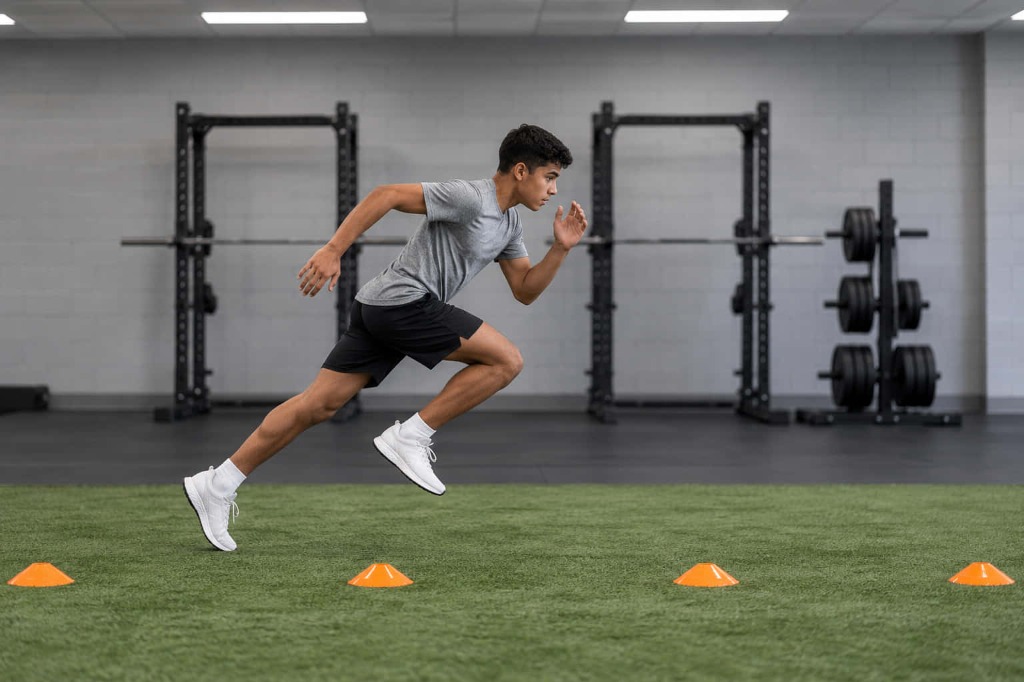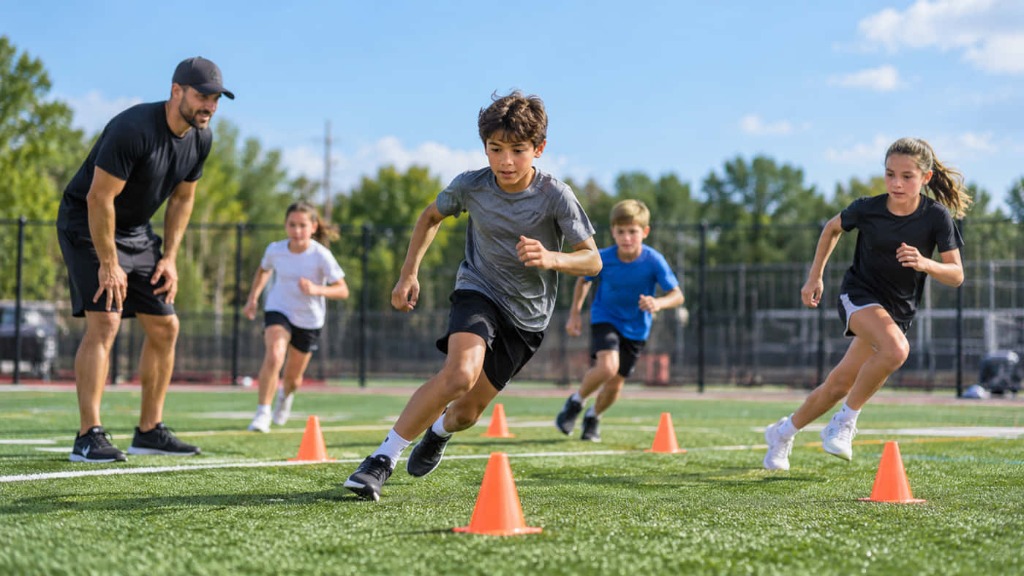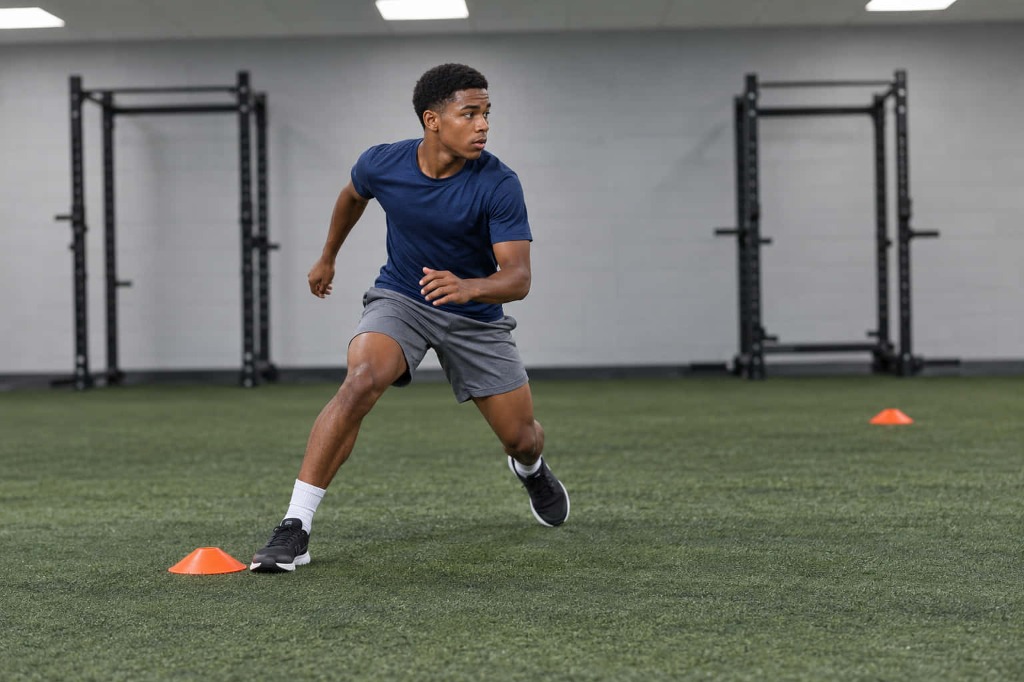
Picture an athlete who finishes a cone drill in a great time. Then a defender steps left, and the athlete hesitates. Coaches and parents see this often, and it raises a fair question: did the drill measure the right thing?
The speed vs agility question matters because the terms overlap without meaning the same thing. This article defines each quality and matches drills to it. It also shows how to measure the quality you want to improve.
What Is Speed, Agility, and Quickness?
Speed is how quickly an athlete covers distance. It includes acceleration from a standstill and straight-line sprinting. Coaches time it over a fixed distance.
Agility is a rapid whole-body movement that changes speed or direction in response to a stimulus. Sheppard and Young’s agility review uses this definition and separates agility from pre-planned change of direction. The stimulus might be a defender, a ball, or a coach’s signal. Without a stimulus, the task is change of direction, not agility in the strict sense.
Quickness is the loosest of the three terms. Coaches use it for a fast first step, a fast reaction, or fast footwork. Agility vs quickness causes most of the confusion. Quickness has no single standard definition as a separate quality, so its meaning depends on the task.
| Quality | Practical meaning | Example | Suitable measurement |
|---|---|---|---|
| Speed | Covering distance quickly | Sprinting to a loose ball | Timed sprint over a fixed distance |
| Planned change of direction | Cutting along a known route | Running a set cone course | Timed known course, such as the 5-10-5 |
| Agility | Changing speed or direction after a cue | Mirroring a partner’s cut | Timed or scored task with an unpredictable cue |
| Quickness | A fast start or response; the term varies | Reacting to a dropped ball | Define the task first, then pick a test |
Define the desired outcome before choosing a drill. “Get quicker” is too vague to train or test. “Accelerate faster over five yards” points to a specific drill and measurement. So does “respond faster to a defender.”
How These Skills Appear in Different Sports
Sports combine these qualities, so no sport belongs to just one. Use the table to find the main demand, then check the others.
| Sport situation | Main movement demand | Relevant quality | Example assessment or drill |
|---|---|---|---|
| Basketball: closing out on a shooter | Short burst, then braking and cutting | Acceleration, agility | Timed 10-yard sprint; partner mirror drill |
| Soccer: beating a defender one-on-one | Changing direction after reading a defender | Agility, planned change of direction | Cue-based cutting drill; timed cutting course |
| Football: breaking on a pass | Sudden stop, then a drive toward the ball | Acceleration, change of direction | 5-10-5 shuttle; coach-signaled break drill |
| Baseball or softball: fielding a ground ball | Explosive first step, then a lateral move | Speed, quickness | Timed 10-yard sprint; ball-drop reaction drill |
Drills That Train Each Quality
Speed and agility training works best when each drill has one clear purpose. These athletic movement skills call for different tasks:
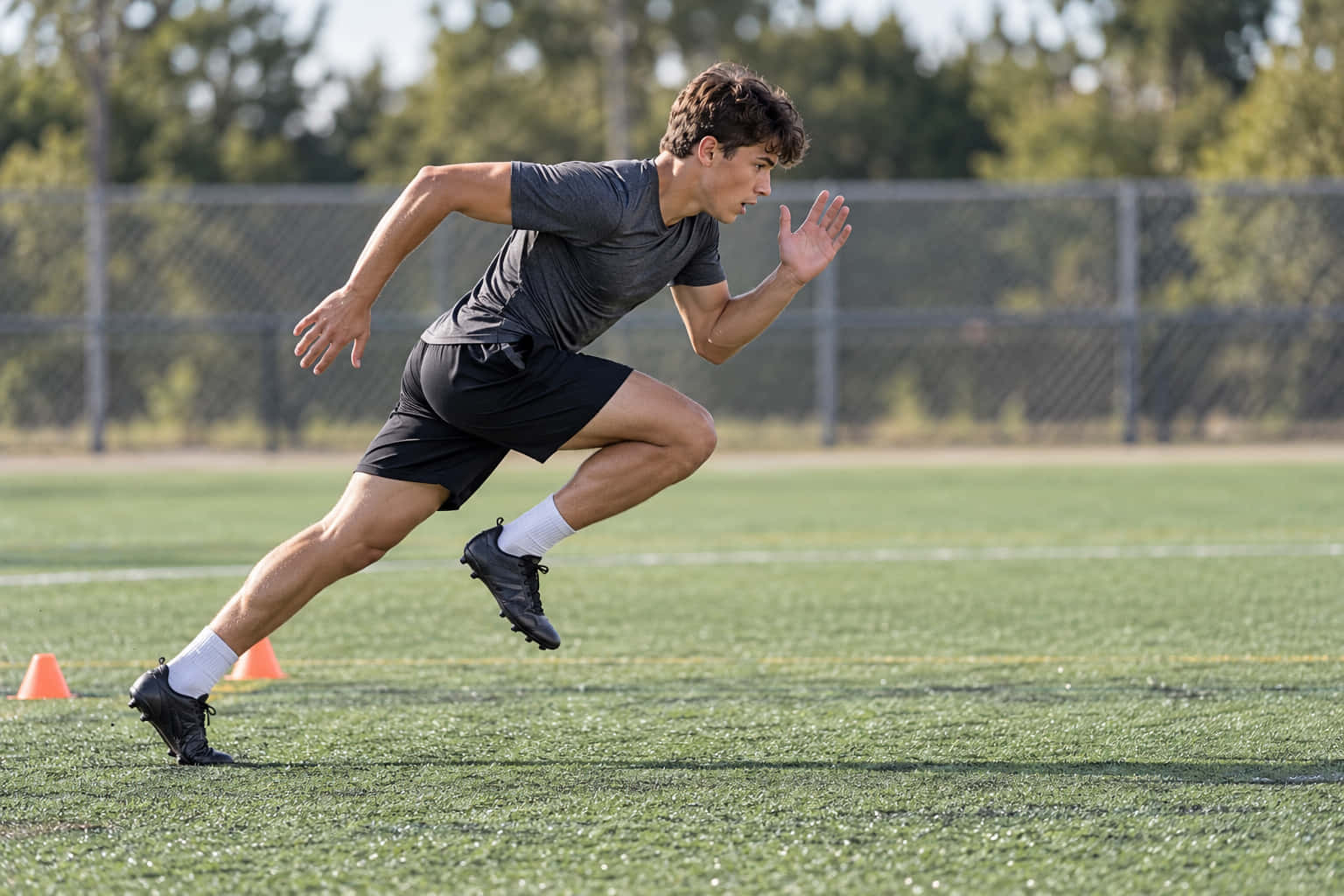
1. Speed: Short Acceleration Sprints
Sprints of 5 to 20 yards, with full rest between reps, train force production from a standing or staggered start.
- Coaching point: Look for a forward body lean and powerful, low steps early, not upright, choppy ones.
- Limit: Sprints do not train cutting or decision-making.
2. Planned Change of Direction: Controlled Cutting and Deceleration
A 5-10-5 shuttle or a “stop and hold” drill trains braking, foot placement, and re-acceleration along a known route.
- Coaching point: Watch for lowered hips and a planted outside foot, with the knee tracking over the toes.
- Limit: The athlete knows the route, so the drill does not train reading a cue. This is the core of change of direction training.
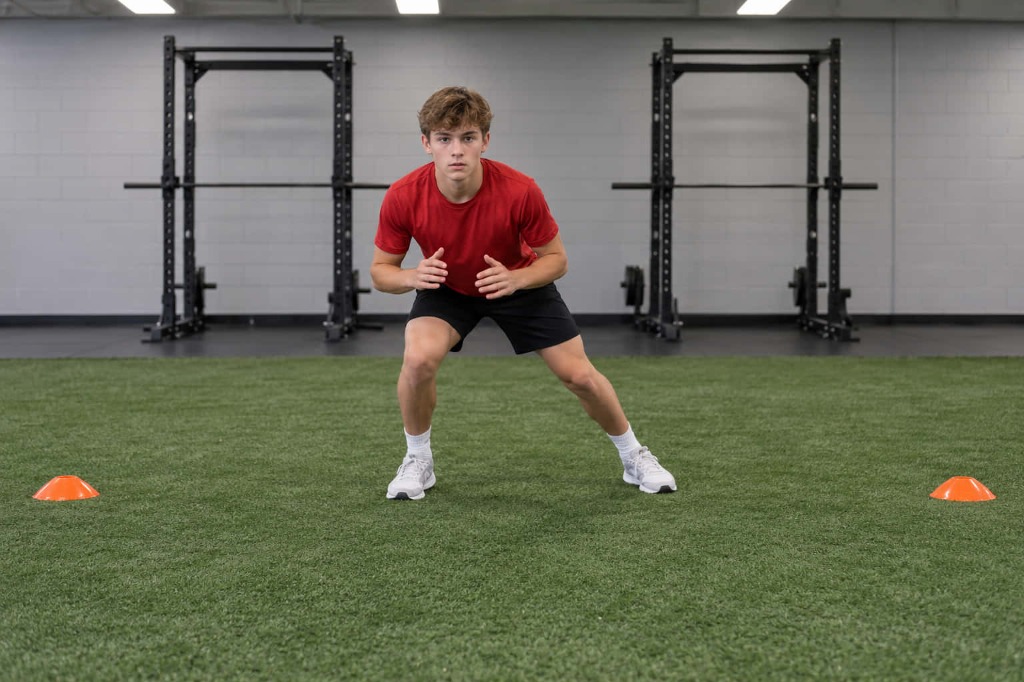
3. Reactive Agility and Quick Responses: Coach-Called or Visual Cues
Partner mirror drills, coach-called directions, or unpredictable visual signals train perceiving a cue, choosing a response, and moving.
- Coaching point: Check that the first step follows the cue, not a guess.
- Limit: Results depend on how unpredictable the cue is, so progress from simple cues to complex ones.
How Coaches Can Measure Progress
Match the measurement to the goal. Each test answers one question and misses others.
| Training goal | Suitable measurement | What it does not show |
|---|---|---|
| Acceleration | Timed short sprint, such as 10 yards | Cutting or reaction |
| Linear speed | Timed longer sprint over a fixed distance | Direction change |
| Planned change of direction | Timed known course, such as the 5-10-5 | Response to a cue |
| Reactive agility | Task with an unpredictable cue, timed from the cue to the finish or scored for correct responses | Straight-line speed alone |
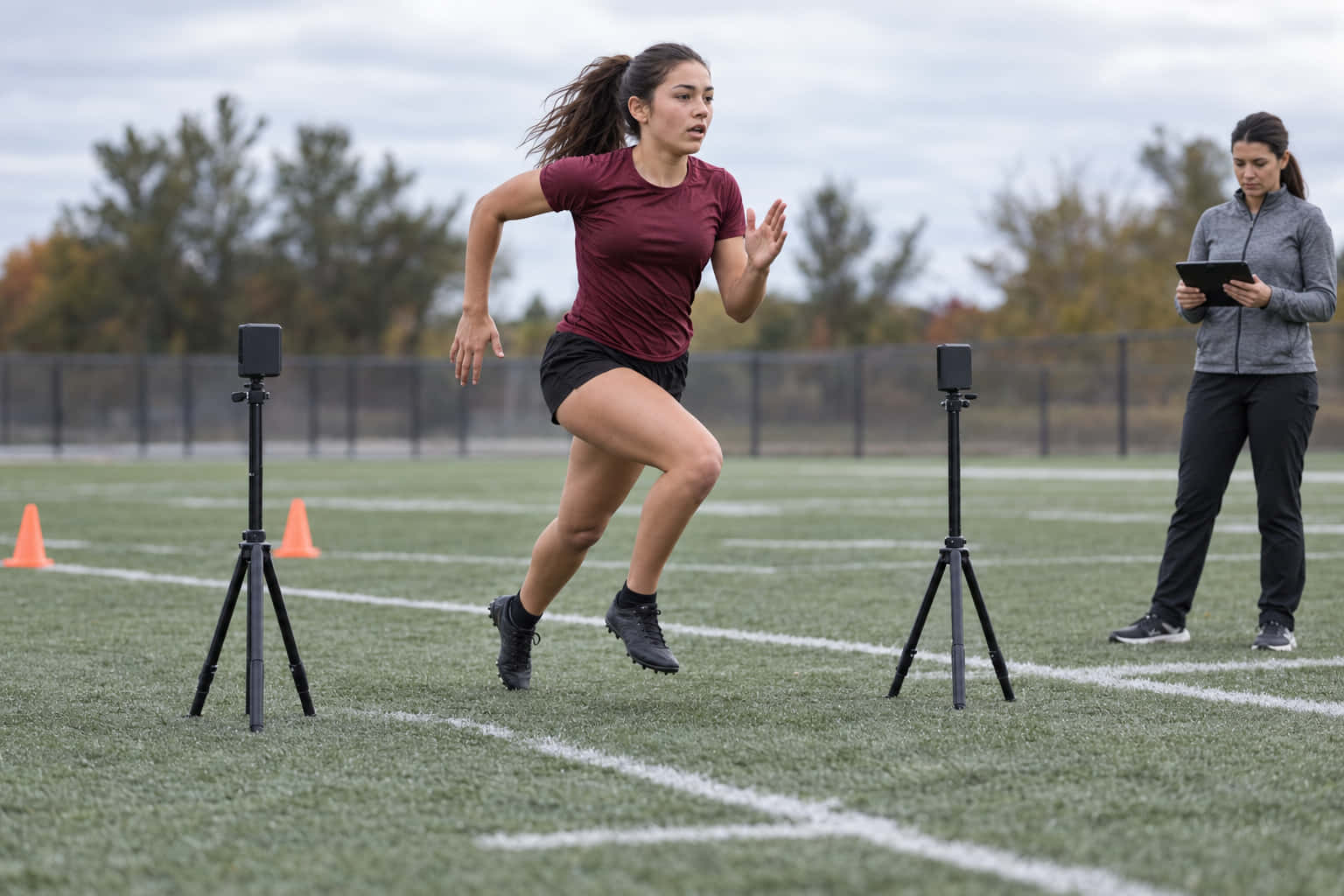
Keep conditions consistent: same surface, footwear, warm-up, start position, and timing method. One test cannot represent every athletic quality. Skip universal benchmark times. Compare each athlete with his or her own earlier results under the same conditions.
Why Reactive Agility Is Different From a Planned Cone Drill
A planned drill tells the athlete the route in advance. A reactive drill requires a response to an external cue, such as a partner’s cut or a visual signal.
This difference matters when you read research. A 2026 systematic review and meta-analysis pooled 22 studies of speed, agility, and quickness (SAQ) training (Ji, Wang, & Yang, 2026). The athletes played basketball, soccer, or handball and were aged 9 to 26. Compared with controls, SAQ training improved planned change-of-direction speed (SMD −0.71, 95% CI −0.92 to −0.51). It also improved linear sprint performance (SMD −0.90, 95% CI −1.18 to −0.62).
These are standardized effects, not percentages or guaranteed time gains. Negative values mean faster times. The authors noted varied study methods and possible publication bias.
The findings support SAQ training for those measured outcomes. They do not show that every SAQ drill improves every quality. Should a coach assume an athlete improved reactive agility after getting faster on a planned cone course? No. Measure reactive agility separately when it is the goal.
A short side-by-side video shows the contrast. The same athlete cuts along a known route, then changes direction after an unpredictable visual cue. The video shows the task difference. It does not isolate reaction time perfectly.
Frequently Asked Questions
What is the difference between speed and agility?
Speed is how fast an athlete covers distance. Agility is changing speed or direction in response to a stimulus. A sprinter shows speed. A defender mirroring a dribbler shows agility.
Is quickness the same as agility?
No. Quickness usually describes a fast first step or fast response. Agility requires reacting to a stimulus and changing direction. Define quickness before you train or test it.
Is a cone drill an agility drill?
Usually not in the strict sense. A known route is planned change of direction. Add an unpredictable cue, and it becomes agility.
How can coaches test reactive agility?
Use a task with an unpredictable cue, such as a partner’s cut, and time or score the response. Keep the setup identical at each retest.
Can an athlete be fast but have poor agility?
Yes. Straight-line speed and responding to cues are partly separate qualities. A fast sprinter may still struggle to read and react. Measure both.
Final Takeaway
Speed vs agility comes down to one question: does the athlete know the route in advance? Identify the movement problem first, choose a matching drill, and measure that same quality.
For help matching drills to a young athlete’s needs, explore Peak Fitness Academy’s Speed & Agility Training programs in Mooresville, NC.